There’s a Rock Stuck in My Shoe!

Today I walked a labyrinth.

An ancient spiritual tool, a labyrinth is sometimes confused with a maze whose purpose is to disorient or deceive. A labyrinth has only one path that is well-defined and leads to the center of the labyrinth and back out again. It is designed to encourage the use of intuition and imagination in order to increase our sensitivity to listen to God.

The labyrinth I walked is located at Mo Ranch Conference Center near Hunt, Texas. Bisected by the beautiful Guadalupe River, the ranch nestles in the Hill Country. Because my husband serves on the board, I go with him to his twice-a-year meetings and make it a point to go to the labyrinth. It is often the highlight of my trip. It is not unusual for me to have some trepidation wondering if I will hear God and what I will hear. Sometimes I bring a specific question. Sometimes I bring a problem. Sometimes I simply desire to bask in the presence of God allowing him to determine the topic of discussion. But on this visit I knew my need was confession.

The labyrinth is located on the far side of the river from the rest of the Ranch and all of the noise and activity that goes along with hosting various groups ranging from children to senior adults. Even though it’s possible to use a car to get close to the labyrinth, I prefer to walk. I have found that the rather strenuous walk prepares me for my intended meeting with God.

First, I traverse the roadways up and down inclines, some gentle, some steep. Then the course takes me across a road that skims just above the river–in Texas we call it a low water crossing. From there a shady path covered in cedar mulch passes between the river on the right and the gently rising hillside to the left. Squirrels and birds dance and sing among the trees. As the path bends and curves up the hillside, the scenery, fragrances and sounds quiet my mind and heart preparing me for my time at the labyrinth.

Approaching the labyrinth

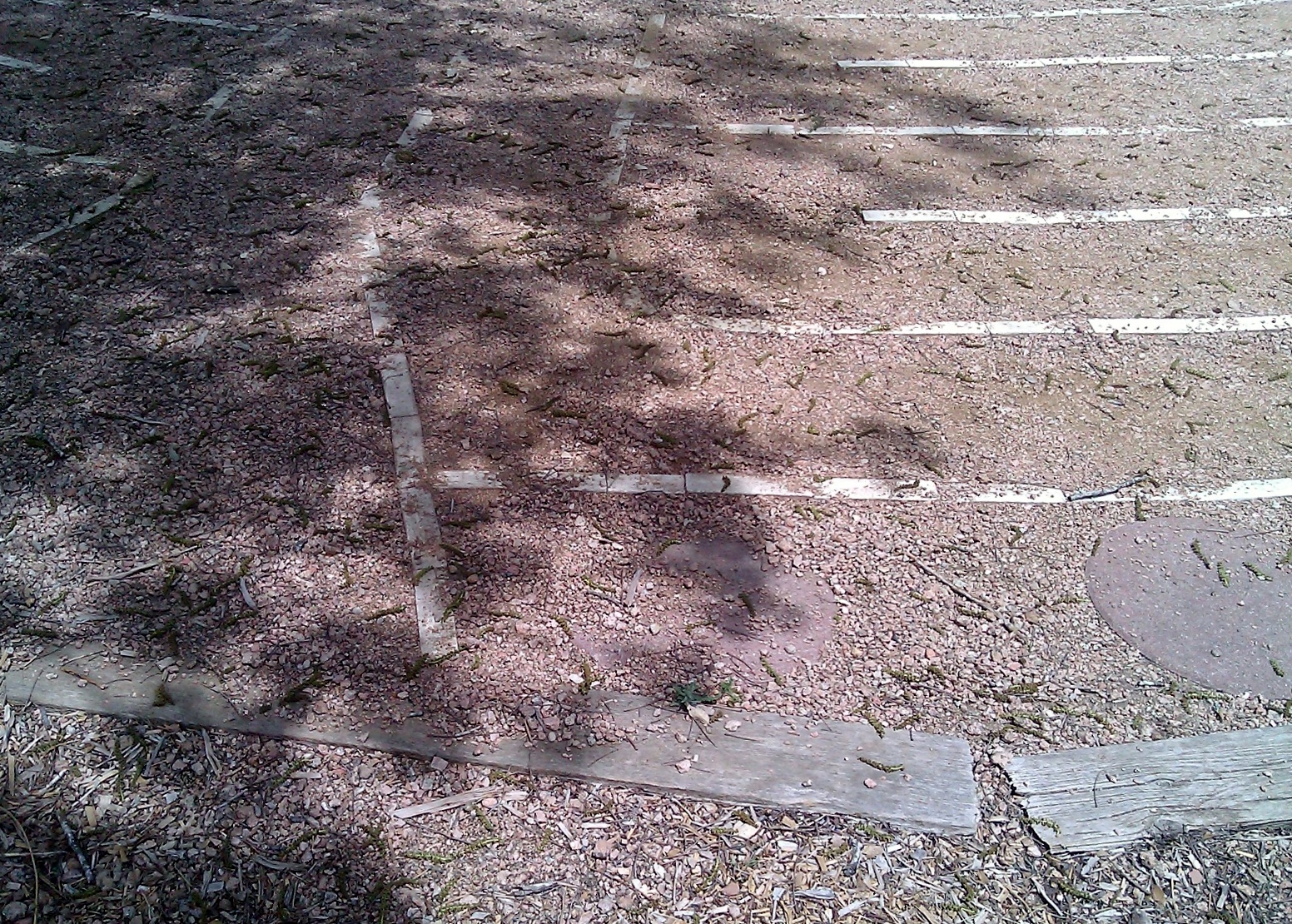
The labyrinth itself is a path of 11 concentric circles with a twelfth circle that is the center. There are large rocks in the center in case a pray-er wants to sit for a while. To do the walk a pray-er walks inward on the circular path, reaches the center and then walks the circular paths out again. Oftentimes I have the sensation that I have wound myself up and wound myself out. It seems that would be stressful, but the contrary is true. The circuitous walk leaves me peacefully unburdened at the end.
Labyrinth pathway
Labyrinth pathway

This time, however, I did something different. Before I started walking the labyrinth’s path, I walked along the outer edge that is marked with round paving stones just to get my mind emptied before I started. I had gone about five steps when I noticed that I had a rock in the tread of my shoe. I scrapped my foot against a paver but the rock was still there. When I turned my foot up, I saw that a rather large rock had lodged itself in a pocket of tread. It was in there so tight I had to pry it out with my fingers.

Through my prayer walk I could not get that stone out of my mind until I understood that it was like the habits and thoughts and attitudes I was laying open before God in my confession. I wanted these things to stop coming between me and God. That’s when I knew I did not get that stone stuck in my shoe by accident.  Just as there are rocks that have to be pried out of my shoes, my life accumulates sins that have to be pried out of my heart. They will not come out with simply scrapping or wishing or rationalizing or ignoring. The rock hampered my physical walking just as my sin–the thoughts and actions that come between me and God–hamper my spiritual walking.

On the labyrinth instruction sheet, Mo Ranch includes this quote from T.S. Elliot: What we call the beginning is often the end, and to make an end is to make a beginning. The end is where we start from. Walking the labyrinth is only the beginning. When I stepped out of the labyrinth, the work of prying out the rocks began.

You probably don’t have access to a labyrinth today, but I urge you to spend time reflecting. What rock is stuck in your shoe?


Does It Hurt on the Inside?

I pulled up the right leg of my jeans and revealed a long scar running parallel to my shin bone. My neighbor had broken her ankle and, for the first time in her life, was on crutches. So, of course, I had to tell her about the only time I’ve ever been on crutches.

It was in 1983. My youngest son was 2 years old. We were at home getting ready to leave for the day. I picked up a large glass jar, the kind in which old-fashioned candy stores displayed Tom’s candies, but I collected loose change in mine. As I walked to the kitchen table to count out change for a vending machine lunch, somehow I tripped and fell on top of the jar. It broke and a very large piece cut my leg about halfway through the calf. My greatest fear had come true: being home alone with a small child and becoming incapacitated. I managed to call my husband. He got to the house in record time, took Joe to a neighbor’s house and put me in the car. Our first stop was the minor emergency center where they packed the wound, wrapped my leg in bandages, and sent me to Brackenridge, Austin’s trauma hospital. That’s when I knew the cut was really bad and not something I was going to recover from in just a few days.

At the hospital they put me on a gurney and wheeled me into the emergency room. Butch stayed in the office area filling out paperwork. A nurse started cutting off the bandages. She suddenly left. A few minutes later she came back with another nurse and, standing right by my gurney, said, “It looked so bad, I didn’t know what to do”, further increasing my fear that this was really bad. After they got me cleaned up, they put the packing back in the cut and left. Soon the emergency room doc came by, looked at my wound and said he would have to call a plastic surgeon to stitch it up. Then he put the packing back in and left.

I was still lying there all by myself because Butch was doing paperwork—how long can that take? A young man came over and said, “May I look at your wound?”

“Sure”, I said, thinking he was the plastic surgeon.

He took the packing out, thanked me and put the packing back in and left. That’s when I remembered that Brackenridge was a teaching hospital. Two or three other student doctors came by and repeated the process, each time not talking to me or looking at me.

Then three EMT trainees stopped by my gurney and asked if they could look. As one of them was taking out the packing, another one looked at me and asked, “Does it hurt?”

“No”, I said.

He said, “It doesn’t hurt on the outside, but it hurts on the inside, doesn’t it?”

“Yes”, I said and the tears started. Amazingly up to this point, I had not cried and the cut had not hurt. Shock, I suppose.

Telling my neighbor this story got me to thinking that there are lots of things that don’t hurt on the outside, but they hurt on the inside. And no one knows. Worse, it can seem as if no one wants to know.

Yesterday I flew to Denver on Southwest Airlines. I read a Kindle, but there is time taking off and landing when all electronic devices must be switched off. That’s when I read the in-flight magazine; on Southwest it’s called Spirit. An article titled “A Story in Black and White” caught my eye.

The article began with a story that took place in the 1970s. The narrator recognizes that her co-worker, Shirley, was in a lot of pain, “that something had cost her.” That something was her mixed-race marriage: he, Pat, was black and Shirley was white and Jewish. They married in 1952 and lived in San Francisco near the neighborhood where Shirley’s family lived. For Shirley to marry someone who was not Jewish was bad enough. It was even worse that he was of color. Her family would probably have reacted by sitting shiva for her, mourning because she would have been considered dead. So Shirley and Pat hid their marriage from her family. Her mother visited every week and every week Shirley gathered up everything that indicated a man lived there and hid the things in the basement. Pat would leave the house, but sometimes he too would hide in the basement. He died in 1974 leaving Shirley with a hurt on the inside that didn’t show on the outside.

How many things do I carry around on the inside that don’t show in the outside but still hurt? Carrying those hurts on the inside and not letting them get to the outside, does not allow healing. Sharing those hurts with a trusted individual gets them to the outside. The light of day has a healing effect. I think of it as coming clean, confession.

For me, the thing I kept inside for many years was the fact that I was pregnant when Butch and I got married. I think most people guessed it when they found out we got married in high school which was another fact I kept inside. I had been married about 25 years when I realized that the greatest blessing God had given me was my marriage. If that’s what I believed, then I needed to come clean so others would know the greatness of God. I was keeping my light under a bushel. Little by little, I began to come clean, telling trusted friends and slowly widening the circle as I got used to saying out loud what I had kept secret for so long. Coming clean, exposing my secret to the light of day, brought healing. Several times I found I was confessing to someone who had experienced the same thing and my confession gave them permission to bring their secret to the light of day.

So what about you? Is there something that hurts on the inside but not on the outside? Is there something that needs the light of day to begin healing? I encourage you to find a trusted person to talk to and come clean. Expose your secret to the light of day and experience healing.

If you feel safe in this forum, I’d love to hear from those of you who have a story to share about something that hurts on the inside but doesn’t show in the outside.

Confessions

I have a confession. I am an NPR junkie. I listen every day to my local public radio station, KSTX, and shows like “Fresh Air”, “Talk of the Nation”, “The World” and “All Things Considered”. Today I heard a news story about a complaint made to a school concerning Bible verses on banners at football games. A group, Freedom from Religion, asked that verses be banned from banners. That infuriated me. For one thing I am a Christian and I believe the Bible is the inspired word of God. For another thing, I live in the United States. We still have the First Amendment, don’t we? Whether I’m a Christian, a Mormon, a Jew, or a Muslim, I have the right to say whatever I want to say.

The school district buckled under, separation of church and state, you know. But the school isn’t forcing the students to put Bible verses on their banners; it is their own idea. And that’s First Amendment rights. Not church and state.

Many Christians will lament that there is a war on Christianity in our country. We can’t mention Jesus, can’t wish a Merry Christmas, can’t pray before public events. We blame the government and groups like the Freedom From Religion. But I think the blame rests first with ourselves.

I live in an area of my city that has a high population of Jewish believers. There is a synagogue on a major road that leads to my subdivision. On the Jewish sabbath and other holy days, it is not unusual to see Jews walking to worship, crossing four lanes of traffic, pushing baby strollers, sunshine or rain. They are walking while all the rest of the world is whipping by them at forty-five miles an hour, if they are obeying the speed limit. The Jews are counter-cultural. They have ample evidence that there is a war on Judaism. And yet, they walk as their religion dictates while the world does what the world is going to do.

So the war on Christianity. My theory is that if everyone who called, or even thought, themselves to be a Christian, even if it was just Christians who actually went to church, if all of those Christians stood up and lived as Jesus modeled and taught how to live, our culture would look very different. There would be visible evidence in things like Bible verses on  football game banners, praying out loud before a public event, using the name of Jesus seriously and not as a thoughtlessly tossed pejorative, and wishing everyone a Merry Christmas during the appropriate time of year. More than that it would be treating others as I would have others treat me. It would be considering the interests of others above my own interests. It would be exhibiting a character distinguished by love, joy, peace, patience, kindness, goodness, faithfulness, gentleness,  and self-control. The war on Christianity? Game over or, at least, changed.

Even as I write these highfalutin words, my conscience is pricked. Just yesterday, I had an opportunity to pray out loud before a non-church meeting. Christians were present as well as non-Christians. I was confident I would not be chastised and yet I failed to pray as if I was talking to God.  I failed to pray in Jesus’ name. I failed.

My challenge to myself and to you, dear reader, is to be counter-cultural. If you are a Christian, live as you believe Jesus would have you live no matter what is going on around you. Let the traffic whiz while you walk. Let the world do what the world will do. As for me, I will follow my Lord Jesus.

[click here to see the news story about the football banners mentioned above]