Does It Hurt on the Inside?

I pulled up the right leg of my jeans and revealed a long scar running parallel to my shin bone. My neighbor had broken her ankle and, for the first time in her life, was on crutches. So, of course, I had to tell her about the only time I’ve ever been on crutches.

It was in 1983. My youngest son was 2 years old. We were at home getting ready to leave for the day. I picked up a large glass jar, the kind in which old-fashioned candy stores displayed Tom’s candies, but I collected loose change in mine. As I walked to the kitchen table to count out change for a vending machine lunch, somehow I tripped and fell on top of the jar. It broke and a very large piece cut my leg about halfway through the calf. My greatest fear had come true: being home alone with a small child and becoming incapacitated. I managed to call my husband. He got to the house in record time, took Joe to a neighbor’s house and put me in the car. Our first stop was the minor emergency center where they packed the wound, wrapped my leg in bandages, and sent me to Brackenridge, Austin’s trauma hospital. That’s when I knew the cut was really bad and not something I was going to recover from in just a few days.

At the hospital they put me on a gurney and wheeled me into the emergency room. Butch stayed in the office area filling out paperwork. A nurse started cutting off the bandages. She suddenly left. A few minutes later she came back with another nurse and, standing right by my gurney, said, “It looked so bad, I didn’t know what to do”, further increasing my fear that this was really bad. After they got me cleaned up, they put the packing back in the cut and left. Soon the emergency room doc came by, looked at my wound and said he would have to call a plastic surgeon to stitch it up. Then he put the packing back in and left.

I was still lying there all by myself because Butch was doing paperwork—how long can that take? A young man came over and said, “May I look at your wound?”

“Sure”, I said, thinking he was the plastic surgeon.

He took the packing out, thanked me and put the packing back in and left. That’s when I remembered that Brackenridge was a teaching hospital. Two or three other student doctors came by and repeated the process, each time not talking to me or looking at me.

Then three EMT trainees stopped by my gurney and asked if they could look. As one of them was taking out the packing, another one looked at me and asked, “Does it hurt?”

“No”, I said.

He said, “It doesn’t hurt on the outside, but it hurts on the inside, doesn’t it?”

“Yes”, I said and the tears started. Amazingly up to this point, I had not cried and the cut had not hurt. Shock, I suppose.

Telling my neighbor this story got me to thinking that there are lots of things that don’t hurt on the outside, but they hurt on the inside. And no one knows. Worse, it can seem as if no one wants to know.

Yesterday I flew to Denver on Southwest Airlines. I read a Kindle, but there is time taking off and landing when all electronic devices must be switched off. That’s when I read the in-flight magazine; on Southwest it’s called Spirit. An article titled “A Story in Black and White” caught my eye.

The article began with a story that took place in the 1970s. The narrator recognizes that her co-worker, Shirley, was in a lot of pain, “that something had cost her.” That something was her mixed-race marriage: he, Pat, was black and Shirley was white and Jewish. They married in 1952 and lived in San Francisco near the neighborhood where Shirley’s family lived. For Shirley to marry someone who was not Jewish was bad enough. It was even worse that he was of color. Her family would probably have reacted by sitting shiva for her, mourning because she would have been considered dead. So Shirley and Pat hid their marriage from her family. Her mother visited every week and every week Shirley gathered up everything that indicated a man lived there and hid the things in the basement. Pat would leave the house, but sometimes he too would hide in the basement. He died in 1974 leaving Shirley with a hurt on the inside that didn’t show on the outside.

How many things do I carry around on the inside that don’t show in the outside but still hurt? Carrying those hurts on the inside and not letting them get to the outside, does not allow healing. Sharing those hurts with a trusted individual gets them to the outside. The light of day has a healing effect. I think of it as coming clean, confession.

For me, the thing I kept inside for many years was the fact that I was pregnant when Butch and I got married. I think most people guessed it when they found out we got married in high school which was another fact I kept inside. I had been married about 25 years when I realized that the greatest blessing God had given me was my marriage. If that’s what I believed, then I needed to come clean so others would know the greatness of God. I was keeping my light under a bushel. Little by little, I began to come clean, telling trusted friends and slowly widening the circle as I got used to saying out loud what I had kept secret for so long. Coming clean, exposing my secret to the light of day, brought healing. Several times I found I was confessing to someone who had experienced the same thing and my confession gave them permission to bring their secret to the light of day.

So what about you? Is there something that hurts on the inside but not on the outside? Is there something that needs the light of day to begin healing? I encourage you to find a trusted person to talk to and come clean. Expose your secret to the light of day and experience healing.

If you feel safe in this forum, I’d love to hear from those of you who have a story to share about something that hurts on the inside but doesn’t show in the outside.
Visible and Invisible

What frustrates you?

What ratchets up your blood pressure making it hard to think clearly?

What makes you want to throw something?

Your answer?

Here’s mine: computers and their close relative, the internet. The thing I want to throw? My computer, of course.

Take Monday, for instance. Since computers are a source of my frustration it doesn’t make much sense that I would sign up for an online course, but that’s what I did. The class, offered through the continuing education department of our local school district, was scheduled to start on October 3.

Bright and early on Monday, the first day of class, I clicked on the link for the online courses and was presented with the home page. I entered the user name and password that I had used to register for the class. The site returned a message that one or both of these were not correct. I thought that perhaps I mis-typed and tried again with the same result. I checked to be sure I was using the correct user name and password. I was.

There it was, the first prick of frustration.

“Perhaps,” I thought, “I need to create a new account for the class.” There was not an option for creating a new login. Frustration noticeably increased.

A few days before the first class day, I had received a cryptic message from the continuing education office that contained a contact name, email address and phone number just in case I had any questions or problems which, as it happened, I was currently experiencing. I called the number and was confronted with an automated voice and several choices, none of which seemed to fit my situation exactly. I did not choose wisely, got disconnected and had to start all over. This time I choose the right one and found myself on hold. After almost two minutes a message came on that they were having “unusually high calling volumes”, but I could leave a message by pressing 1. I pressed 1 and was promptly disconnected.

The frustration was so thick that I couldn’t think clearly. I was drowning in a sea of black with no one to save me, no friendly hand to haul me out of the miasma, no lifesaver thrown to my rescue.

There was an email address though. Email sent. And I waited. For the rest of the day.

Finally, I told my husband about my problem. This is always my last resort, because he hates the way I have my personal computer–emphasis on personal–set up. So not only is it frustrating for me, it’s frustrating for him. He had no better luck getting in than I did, except that he was smart enough to go to the school district’s website, found the direct number of the community education contact person and left her a voice mail. Now we both waited.

Next day: I tried the login credentials again thinking that perhaps they were having trouble with their site. It happens. But not this time.

Phone number again. I steeled myself for voice mail hell. To my surprise, I got a human. She couldn’t help me, but the woman who could would call me back in five or ten minutes. “What are the odds?” I thought, rolling my eyes.

Butch and I went to lunch, Subway, my favorite for weekday lunch. While we were there, he got an email from the district woman with new login credentials for me and a promise to help if I have any more problems.

I know that frustration with my computer grows out of the reality that I don’t understand it. Then add the internet which resides I-don’t-know-where. If I can’t see it, how am I going to understand it?

However, there are lots of other things in my life that cause me frustration. Some I can see, like people, and some I can’t see, the internet. And I know, but don’t like to admit, frustration is an unavoidable part of life.

While ruminating on this, a Bible verse popped in my head, one I memorized a long time ago. It goes something like this: in Jesus all things were created, things that are visible and things that are not visible*. My computer and the internet fall in there somewhere. But so do the weeds in my yard, the gray hairs on my head, and the disagreeable checker at the grocery store. Visible and invisible includes all the things that cause frustration. Because Jesus created them, he is able to handle them for me. I can place my frustration in his hands and get it out of my heart.

The emailed login credentials worked. I’m in. I’ve completed the first week’s lessons. Things visible and invisible. No more frustration… at least for now.

* Colossians 1:15-20

Confessions

I have a confession. I am an NPR junkie. I listen every day to my local public radio station, KSTX, and shows like “Fresh Air”, “Talk of the Nation”, “The World” and “All Things Considered”. Today I heard a news story about a complaint made to a school concerning Bible verses on banners at football games. A group, Freedom from Religion, asked that verses be banned from banners. That infuriated me. For one thing I am a Christian and I believe the Bible is the inspired word of God. For another thing, I live in the United States. We still have the First Amendment, don’t we? Whether I’m a Christian, a Mormon, a Jew, or a Muslim, I have the right to say whatever I want to say.

The school district buckled under, separation of church and state, you know. But the school isn’t forcing the students to put Bible verses on their banners; it is their own idea. And that’s First Amendment rights. Not church and state.

Many Christians will lament that there is a war on Christianity in our country. We can’t mention Jesus, can’t wish a Merry Christmas, can’t pray before public events. We blame the government and groups like the Freedom From Religion. But I think the blame rests first with ourselves.

I live in an area of my city that has a high population of Jewish believers. There is a synagogue on a major road that leads to my subdivision. On the Jewish sabbath and other holy days, it is not unusual to see Jews walking to worship, crossing four lanes of traffic, pushing baby strollers, sunshine or rain. They are walking while all the rest of the world is whipping by them at forty-five miles an hour, if they are obeying the speed limit. The Jews are counter-cultural. They have ample evidence that there is a war on Judaism. And yet, they walk as their religion dictates while the world does what the world is going to do.

So the war on Christianity. My theory is that if everyone who called, or even thought, themselves to be a Christian, even if it was just Christians who actually went to church, if all of those Christians stood up and lived as Jesus modeled and taught how to live, our culture would look very different. There would be visible evidence in things like Bible verses on  football game banners, praying out loud before a public event, using the name of Jesus seriously and not as a thoughtlessly tossed pejorative, and wishing everyone a Merry Christmas during the appropriate time of year. More than that it would be treating others as I would have others treat me. It would be considering the interests of others above my own interests. It would be exhibiting a character distinguished by love, joy, peace, patience, kindness, goodness, faithfulness, gentleness,  and self-control. The war on Christianity? Game over or, at least, changed.

Even as I write these highfalutin words, my conscience is pricked. Just yesterday, I had an opportunity to pray out loud before a non-church meeting. Christians were present as well as non-Christians. I was confident I would not be chastised and yet I failed to pray as if I was talking to God.  I failed to pray in Jesus’ name. I failed.

My challenge to myself and to you, dear reader, is to be counter-cultural. If you are a Christian, live as you believe Jesus would have you live no matter what is going on around you. Let the traffic whiz while you walk. Let the world do what the world will do. As for me, I will follow my Lord Jesus.

[click here to see the news story about the football banners mentioned above]

Seasons of Healing

While we were out with our walking group on Saturday morning, a cold front–or cool front–blew in. The breeze picked up to an actual wind. The temperature and humidity dropped. Not only did our bodies feel better, but our spirits lifted. It had gotten to the point in the summer that I wasn’t quite sure it would ever be less than 100 degrees and 99 per cent humidity. And then just like that, the season changed or at least promises to change. A reminder that God is in charge. His natural laws are true and reliable.

Last Wednesday I cut my finger. We had gone to a restaurant that serves giant cinnamon rolls. And I mean giant. They weigh 3 pounds and are about four inches high. But yummy! Cinnamon and sugar all through the entire roll, topped with icing that melts in the between the rolled layers. It is not health food. We took three-quarters of it home in a box and planned to share it with guests. I was cutting our portion off, holding the styrofoam platter behind the roll where I couldn’t see it. I sliced into the index finger of my left hand. Of course, I didn’t want to get stitches; I could heal it with band-aids and ointment. That was almost a week ago. It is still sore, but on the mend. A reminder that God is in control. His natural laws work regardless of our dumb mistakes.

My Aunt Joyce  called on Saturday night. Her husband, Charles, passed away on Friday night. She had moved into a new season: widowhood. Uncle Charles has experienced the healing that was not possible in this world. Joyce is left with the pain of grief. However, as surely as cooler temperatures and as surely as my finger is healing, her pain will be lifted little by little until she experiences with Charles the healing that is possible in the world we cannot see from here. God is in control of the seasons of life. His law of love and grace stands strong and immutable.

What season are you in? What pain are you experiencing? Where do you need healing? No matter what you answer, God is in control of even that.

Beginning of the End

Today is the first day of school. Even though I don’t have kids at home, the school year dictates my calendar. Until next June, I will allow extra time to drive through school zones or, better yet, avoid them if possible. I will stay away from the grocery store after 3:00 in the afternoon, too many moms with tired students in tow grabbing just one more ingredient for dinner. And the lack of traffic on the road at odd hours will remind me of holidays of which I was not aware.

Nevertheless, the first day of school is a nostalgic day for me. Because I was fortunate enough to have been a stay-at-home mom, my whole life revolved around the school calendar. Let’s see, 3 boys times 12 years of school, that’s 36 individual first days of school! However, one year stands out in my memory, because, for that son, it set the tone for all the days to follow.

A  week or so before the start of our oldest son’s freshman year at Churchill High School, we attended orientation night. At the end of the program a slide show took parents and students on a virtual tour of the next four years by showing all the activities that go on at Churchill ending with pictures of graduation. That’s when it hit me. This was it. Trey would be home for four more years. Then he would go off to college and there would be no more first days of school for him.

As we walked to the car, I put my arm around his shoulder and, with tears in my eyes, said, “Well, Trey, this is it, the beginning of the end.”

He looked at me with his biggest smile and earnestly responded, “Isn’t it great!”

Our viewpoints could not have been more different. I was looking down the mountain toward the end of the trek. He was looking up the mountain at the beginning of the trek. Little did I know that he would be gone much sooner than I expected.

It happened in his junior year. For one semester he was an exchange student to Germany and lived in West Berlin at the time the wall was still standing. The sadness and uncertainty of allowing him to go into the unknown was overwhelming. This was in the old-timey days when anyone could go to the gate at the airport; Butch and I, his brothers, Andy and Joe, stayed glued to the window until we saw his plane soar into the air. Six months later I felt like I was flying I was so happy and relieved when we met him at the airport to welcome him home. But this was his beginning. Years later when the wall fell, he called his German host parents from Chile where he was doing a college semester abroad.

He’s an adult now and we are still experiencing beginnings. This Sunday he arrives from Buenos Aires, Argentina, where he now lives, for a thirty-day visit to the states. We will experience another ending when he leaves to go back home.

Yes, for he and I both that night was the beginning of the end. And today for the students in my city it is a beginning of the end with all the anticipation and trepidation that goes with beginnings and endings.  Parents and students, my advice: whether your view is up or down the mountain take it one beginning at a time. The ending will be here before you know it. Relish the beginning and the ending will be that much sweeter.

A Couple of Street Corners and Imagination

A few weeks ago Butch and I took a road trip to Colorado. We’ve spent a lot of time in the southwest so when we go we try to take a route that will take us to a new place. The challenge is that, from where we live, it takes a full day to get out of Texas, unless we head for Mexico. Going west there is not much to choose from; towns are few and far between. As my husband likes to say about west Texas, “It’s not the end of the world, but you can see if from there”. For this journey we decided to take a detour through Midland and Odessa; then shoot across to Roswell and up through Santa Fe to Colorado.

As the trip time neared, we narrowed it down to just Odessa for two reasons. One, Butch has never been to Odessa, not that it’s a garden spot, but it’s something new. I’ve been there once, in high school. My dad took us there when another high school in my district went to the state football championship and played Odessa Permian. In the spirit of the event, we even decorated the windows of the car with shoe polish. At the time I wondered why my dad wanted to go to that particular game. Odessa is a long way from where we lived. I didn’t say anything about it because asking him why he did anything usually didn’t turn out well.

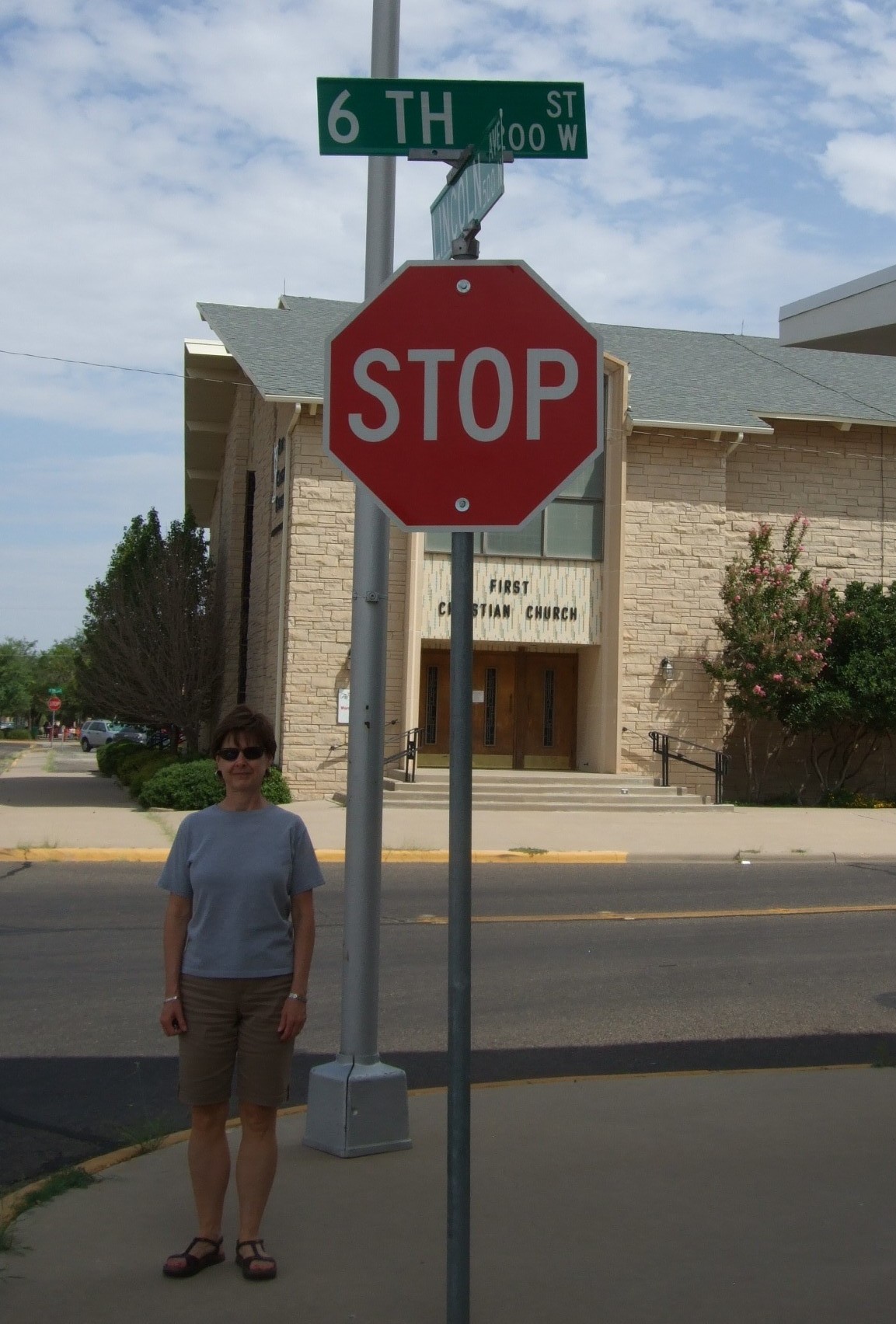
The second reason is that my dad grew up in Odessa. When he retired, Daddy did some genealogy work and had written a short biography of himself which included the location of his boyhood homes. When they first moved to Odessa they lived outside of town; he didn’t give any landmarks or road names. When he was six, they moved to town and lived at S. 6th and Lincoln. His dad’s plumbing and sheet metal shop was at S. 1st across from the T&P railroad depot. He also wrote a paragraph about himself for a book when Odessa High School was having a milestone reunion. In that piece he gave a different cross street (7th Street) for his boyhood home. I anticipated that it wouldn’t be difficult to find the places with these directions. The buildings might not be standing after all this time, but surely the streets will still be there.

We drove into Odessa in the late afternoon of July 22, tired from driving, but excited about finally starting our trip. We checked into a Holiday Inn Express along with sixty or seventy Halliburton workers. The oil boom has once again come to life in west Texas and it has become a busy place.

The next morning we started out. The desk clerk at the hotel gave us a map. We had studied it and got our bearings. With the aid of our GPS, known to us as GyPSy, we drove right to Lincoln and S. 6th.

What did this corner look like in the 1930s when my dad was a boy?

The intersection is now located downtown. A Baptist church spreads across two corners with its parking lot on a third. This seemed appropriate since my dad and mom were members of a Baptist church for over 50 years when they died. An AT&T office building stands on the fourth corner.

Leaving our car in the Baptist church lot, we walked the block to the intersection of Lincoln and S. 7th. This intersection had a Disciples of Christ church and some other office buildings. After taking photos of all the corners, we went to search for Granddaddy’s shop.

S. 1st was nearby and we quickly spotted the railroad tracks. A few buildings lined the tracks, but nothing that looked like a depot and none that looked old enough to have been standing in the 1930’s. Butch went into a shop and asked about the depot. He was directed to another business that had been there much longer. The owner there knew exactly what we were looking for. In fact, the shop had stood across behind his shop. The depot was across the street by the tracks and had been torn down long ago leaving the lot vacant.

Granddaddy’s shop stood on this corner. Across the street was the T&P Depot which no longer exists.

Standing where the shop probably had been and turning towards the north and downtown, we spotted a tall building, probably the tallest one in Odessa. I had noticed it when we were at the boyhood home site. That landmark gave me a sense of the distance my dad had traveled when he went from his house to his dad’s shop, just a few blocks. In those days, without the buildings and the traffic, he could have walked or run–he was a boy after all–the distance in a few minutes.

From his dad’s shop, my dad’s boyhood home stood on the other side of this tall building.

So this is where my dad grew up from about about six or seven years old until  he was in 10th grade and his family moved to Abilene. Daddy has always been a mystery to me. I never understood what made him like he was: non-communicative, independent, emotionally cold, quick to anger. Standing there on those corners in Odessa, I imagined what it must have been like growing up in flat, dry and dusty west Texas. He told me stories about when they lived in the country, stories about climbing up the windmill in high winds and setting the brake and times when he ran away from home. But he didn’t tell any stories about living in town, at least not that I remember.

My dad is gone now. He passed away in 2004. All I have is a couple of street corners and imagination. In Odessa I learned something. All the questions I have about my dad, all the things I don’t understand about him, it’s time to let those things go. He loved me the best he could. It’s up to me to be open and vulnerable with those I love, to let them really know me and not leave them with only a couple of street corners and imagination.

Aspens

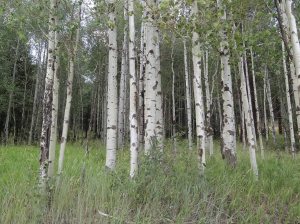
I have recently undertaken a project to make a walking stick out of the trunk of a small aspen tree. In the process I have learned that aspens grow in clonal colonies. These colonies are derived from a single seedling. Each sapling is a sucker that grows from the root system. So in a grove of aspens the tress are inexorably tied together underground. They are a family.

A grove of aspens stretches their trunks straight toward the sky, their exquisitely white bark set off with dark markings and silvery green leaves trembling and shimmering in the breeze. But all aspens do not grow straight; some are crooked. For some reason their trunks have grown twisted or bent. Nevertheless, they remain part of the family, standing firm in the circle among their aspen relatives, an eternal family reunion.

That’s how it is for aspens. What about us humans and our families? There is a connection, an underground thread, that is just as real. The underground thread connects us by blood that is passed through the act of creation. The thread connects through shared history and experiences. And love. There is love which is felt. And love which exists only as a wish, love which is longed for, and love which is the object of hope.

Blood, history, love. An invisible connection, strong and unbreakable. A grove of aspens standing tall and straight, joined by the underground thread.

Consider

This morning officials of the NCAA announced the penalties placed on Penn State in the wake of the sexual abuse scandal: sixty million dollars, all wins from 1998 to 2011 rescinded, no post-season games for four years. A powerhouse football program decimated. The legacy of a man blotted out as if he had never a coached. Too harsh? I don’t think so.

The Bible has a clear exhortation: Consider not only your own interests but also the interests of others (Philippians 2:4). Football was placed over the safety and well-being of little boys, children, the least among us.

The result is that many are suffering, the innocent as well as the guilty: the victims and their families, the convicted and his family, those who lost their jobs in disgrace and their families, football players and students who will suffer the consequences of the NCAA ruling, alumni of Penn State, citizens of State College and of Pennsylvania…the list is endless.

Consider not only your own interests but also the interests of others.

If these words ruled our hearts and minds, what a different world we would live in.

On Deck

Baseball is not a sport I enjoy watching. It’s a little slow-moving for me. However, I enjoy listening to talk about baseball: the stats, the strategy, the technicality of how to throw a baseball and field a ball.

It’s not that I wasn’t exposed to baseball. When I was born my dad bought me a baseball and glove. In school I played baseball in gym class. Not being a very good athlete, I struggled. Catching the ball was difficult; hitting the ball was impossible. When each of my three boys was born, my dad bought baseballs and gloves and taught them to catch. I went to all of my kids’ games.

This morning a friend asked me how I want my time on deck to be spent. Even with my limited knowledge of baseball, I know about on deck.

For those of you who know even less about baseball than I do, on deck refers to being next in line to bat. The player waits in the on-deck circle which is positioned in the foul area between home plate and the team bench. Here the on-deck batter warms up as he waits for the current batter to finish his turn.

Using my friend’s metaphor, when people of the older generation pass away, I am left on deck. Both of my parents are gone as are my husband’s parents. All of my husband’s parents’ siblings are gone. Two of my mother’s are still living and one of their husbands. I’m not on deck yet, but I’ve moved to the end of the bench.

Since this morning the question has been rolling around in my head. How do I want to spend my time on deck? There are several choices. I can spend the time warming up. I can review strategy. I can plan for the kind of pitch that is likely to be thrown.

My first thought and answer was that I want to develop a character that is marked by what the Bible calls gifts of the Spirit: love, joy, peace, patience, kindness, goodness, faithfulness, gentleness, self-control. However, now that I’ve had some time to think about it, my answer is to spend my time on deck building, mending, strengthening relationships with the people who are most important to me–my husband, my children, other family members, my friends. Once I’ve gone to take my turn at bat, the thing that will be left of a lasting nature will be the relationships with the people I love. When they take their position on deck, it may be the relationship we shared that will help them be strong and capable for their turn at bat.

Road Trip: Detour Part Three

On the road of life, detours avoid a road that is dangerous and chaotic. The original woodpile kitty took a detour which took her from a dangerous, chaotic place to a safe, peaceful place. It is my story; perhaps this is your story as well.

It was October in south Texas, a time when the only way to gauge that fall is here is by the way the sun lies low in the sky and not by the temperature. I went out to the garage to talk to my husband when I heard the most pitiful meow.

I looked at him and he looked at me. He had chosen to ignore the meowing. Not me, “I think there’s a kitty behind the garage.” And with that I went to look.

Like an old woman hides her legs under a long skirt, our garage hides a conglomeration of ugly things: a pile of old flower pots, a stack of bricks, a neat-as-a-pin stack of firewood and a ramshackled pile of old wood. But no kitty. I decided that it was probably in one of the neighbors’ backyards.

However, every time I went to the garage, I heard that same meowing. And every time I’d scan the area behind the garage. Sometimes I’d walk around the flower pots, brick stack, firewood, and woodpile, but I did not find a  kitty.

When Butch got home from work I gave him the kitty report. His answer: I think you’ve got Claude Rains back there.

“Huh?” I said.

“Yeah, Claude Rains, the guy who played the invisible man in that old movie. You’ve got the invisible cat out there.”

I knew there was a kitty out there and I was determined to find it. I wanted it to live in my house where it would be safe.

The next day as I walked through the house, I happened to glance out the window. And there, bouncing across the lawn like a baby kangaroo, was a little grey kitty.

Armed with a flashlight I went to search in earnest. Like CSI, I shined my flashlight around the pile of old flower pots, behind the stack of bricks, in the crevices of the neat-as-a-pin stack of firewood. There was only one place left.  I shined my flashlight around and into the ramshackled pile of old wood. I got down on my knees and shined it up into the woodpile and there, glinting in the beam of the flashlight, were two little eyes. Ah-ha! I found it.

I put some food out on the lawn in view of both the house and the woodpile. Slowly but inevitably, the little kitty came out of its hiding place and ate it. I gradually moved the food closer and closer to the patio until the kitty was eating on the patio. In the morning, if we were extremely quiet, we could catch the kitty sleeping on the patio cushions. The slightest noise, and shoom! It was off to the woodpile.

Every day I plotted and planned how to get close enough to catch it. I wanted more than anything for it to live with us in our house.  After about a week, I knew I was not going  to catch it with my bare hands. Not to be deterred, I borrowed a live trap from my veterinarian. The kitty didn’t weigh enough to trip the latch  so Butch rigged it so the door would close. Finally after several attempts, we caught it. And it was mad. Around and around the trap it ran, nothing but a grey blur. When it finally stopped, we took the trap, kitty and all, into the bathroom.

For a couple of days the woodpile kitty lived in our bathroom. I’d go in periodically and pet it and pick it up. When I heard purring, I knew we had ourselves a new kitty. We were able to determine that it was girl. The name? Claude, of course.

After her woodpile experience, she did not like to be petted, much less picked up. Nevertheless we cohabited peacefully.

One morning according to my habit, I went into my study to have a quiet time. Claude came in, sat at my feet and began meowing and meowing. She acted like she wanted to be picked up. So I did. I held her up on my shoulder under my chin and stroked her soft fur. She was so still, cuddling up to me. And then she started purring.

Sitting there in the quiet, I remembered that we had no idea where Claude came from or how she got in the woodpile. I wondered where she would have ended up without our detouring her into our house and family. As I thought about Claude’s detour, I clearly saw my own detour.

I had gotten myself into a woodpile when I got pregnant as a teenager. I knew enough about teen moms to know that I should have been divorced; I should have had multiple children with multiple men. I should not have graduated from high school, much less college. I should have lived in poverty. None of that was true for me. God had detoured me into a life with a husband who loves me, a good marriage, wonderful children, blessings too numerous to list.

I translated Claude’s kitty language of purring into my language. “Thank you”, she said, “thank you for rescuing me from the woodpile. Thank you for inviting me to live with you in your house.” In her little kitty way, she was saying, “I love you”.

Claude and I had each been led on a detour out of the woodpile. Like Claude, there was nothing I could do to repay my rescuer. All that was necessary was the giving of thanks for all my rescuer has done, is doing and will do for me.

Thank you, Father, for the detour out of the woodpile and into your house where it is safe and sound.